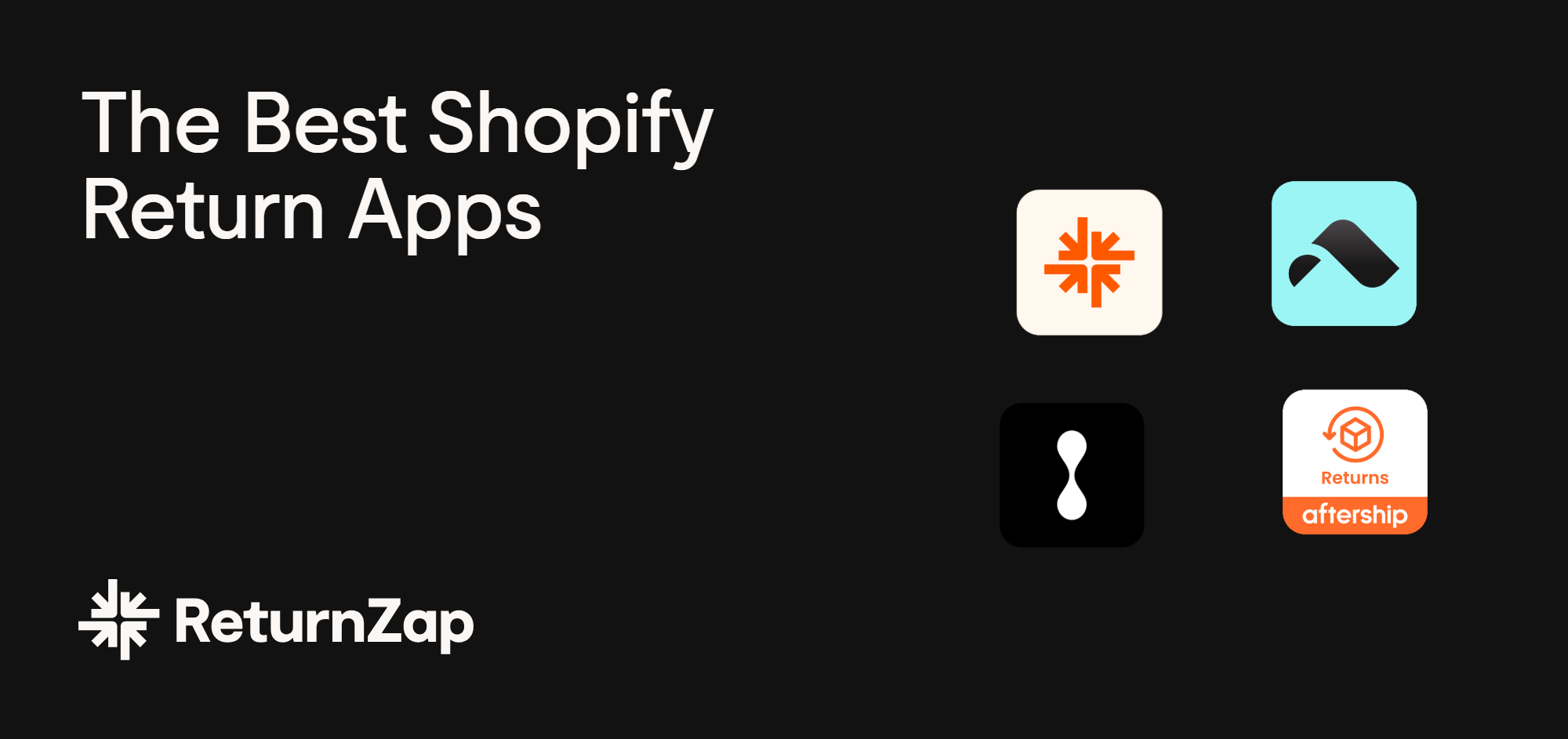
9 Best Shopify Returns and Exchange Apps in 2026
We make ReturnZap, one of the products compared here. That gives us hands-on experience with Shopify returns, but it also gives us an obvious bias. To make the comparison useful, we publish the prices and ratings we checked, explain how we evaluated each app, and point out when a competitor may be a better fit.
Which Shopify returns app is best?
The answer depends on your return volume, budget, and workflow. Mid-sized stores that need flexible exchanges and automation without breaking the bank should compare ReturnZap, AfterShip Returns, and CWILL.
Loop is designed for Shopify Plus brands with larger budgets and dedicated customer experience teams.
Redo suits stores that want no upfront software cost and are comfortable with a shopper-paid model.
Enterprise retailers that need physical drop-off networks should consider Narvar or Happy Returns.
Comparison at a glance
How we evaluated the apps
We considered four factors: the returns features included at each price tier; the tools available to convert refunds into exchanges or store credit; support for labels, carriers, international returns, and warehouse handoffs; and merchant feedback in Shopify App Store reviews. We excluded company size, funding, and vendor-reported brand counts because those figures often combine installs, free-tier users, and customers of other products in the same suite.
1. ReturnZap: best for flexible exchanges and automation
Best for: stores processing 50 to 5,000 returns a month that want flexible exchanges and automation without enterprise-level pricing, and brands that want returns handled natively inside Shopify rather than through a separate platform. It is also a strong Loop alternative for Shopify Plus brands.
Pricing: Pro starts at $39 per month, and Advanced starts at $69 per month. Both scale with return volume. A 14-day free trial is available, but there is no free tier.
Strengths: ReturnZap is Built for Shopify certified and works entirely inside Shopify. Returns, exchanges, refunds, and store credit are created as native Shopify objects, so they show up in the order timeline, sync with inventory and reporting, and work with Shopify Flow, POS, and Shopify's own return policies. There is no separate dashboard to log into and nothing to reconcile between systems, which is why brands that want to keep their tech stack simple tend to choose it.
Exchanges are central to the product. Customers can swap an item for any product at any price, and ReturnZap automatically charges or credits the difference. Store credit and bonus credit are built in. Its rules engine manages return windows, fees, exclusions, and routing by product, country, or customer, allowing most returns to be approved and shipped without manual work.
ReturnZap supports labels from multiple carriers and providers, QR codes for label-free drop-off, and a prepaid shipping balance with negotiated rates. It also covers EU withdrawal rules, international return consolidation through partner hubs, and warehouse receiving on the Advanced plan, giving 3PLs advance notice of incoming items. Integrations include Gorgias, Klaviyo, Sendcloud, Shippo, and ShipStation, plus an API and webhooks. ReturnZap has been listed in the Shopify App Store since 2016, the longest tenure among the apps in this comparison, and has a 4.9 rating.
Limitations: There is no free plan, so stores processing only a handful of returns each month will pay more than they would with AfterShip or CWILL. ReturnZap is Shopify-only and does not operate its own physical drop-off network. It is also a smaller company than Loop or Redo, which may matter to merchants that want a large, dedicated account team.
2. Loop Returns: best for Shopify Plus retention teams
Best for: Shopify Plus brands with a CX team, a meaningful returns budget, and a focus on retention metrics.
Pricing: Core is free and includes software plus return shipping in the US and Canada. Essential costs $155 per month, and Advanced costs $340 per month. Loop does not publish per-return fees or included volumes, so merchants should request a full quote.
Strengths: Loop offers a polished exchange flow. Shop Now lets customers browse the full catalog during a return, while Instant Exchange and Bonus Credit encourage them to choose an exchange instead of a refund. The platform also includes workflows, carrier rate shopping, fraud rules, and at-home pickup. Integrations include Gorgias, Klaviyo, Attentive, Global-e, NetSuite, and ShipHero. With tracking, order editing, and checkout protection, Loop can serve as a broader post-purchase platform.
Limitations: Paid plans start at $155 per month before volume fees, putting them beyond the budget of many smaller stores. Several of Loop's signature exchange features require the Advanced plan. Stores that need only returns management may also end up paying for a broader suite of retention tools they do not use.
3. Redo: best for a shopper-paid returns model
Best for: stores that want returns software at no direct cost and are comfortable adding a paid return-coverage option at checkout.
Pricing: The returns software has no direct fee. Redo earns revenue by selling return coverage to customers at checkout and by offering separately priced modules for checkout optimization, email and SMS, support, and fulfillment.
Strengths: The free returns tier includes a portal, claims, AI-assisted exchange offers, and variant-level analytics. Redo's acquisition of ReturnBear added physical drop-off and in-country processing in many markets. At 5.0 from 692 reviews, Redo has the highest Shopify App Store rating in this comparison. Its wider product range includes tracking, a help desk, email, and checkout testing.
Limitations: The model depends on customers buying coverage at checkout. That adds a line item to the cart and may affect conversion or conflict with a merchant's brand experience. Merchants looking for a focused returns product with conventional, predictable software pricing may prefer another model.
4. AfterShip Returns: best for existing AfterShip customers
Best for: stores already using AfterShip for tracking, and very small stores that want the lowest paid entry price.
Pricing: Return Care is free and uses a shopper-funded model. Essentials costs $19 per month for 20 returns, while Premium costs $119 per month for 100 returns. AfterShip's website lists slightly different prices, $16 and $99, so confirm the current amount before subscribing.
Strengths: AfterShip provides a branded portal, exchanges, store credit, AI-assisted exchange offers, fraud checks, and discounted labels from USPS, UPS, FedEx, and Canada Post. It has the most Shopify App Store reviews in this comparison, with 1,393. Integrations include Gorgias, Klaviyo, Zendesk, ShipStation, and NetSuite. AfterShip also supports ecommerce platforms beyond Shopify.
Limitations: The Essentials plan includes only 20 returns, and its exchange and automation controls are less extensive than those offered by ReturnZap, ReturnGO, or Loop. Merchant reviews also give mixed accounts of support response times.
5. ReturnGO: best for complex policies and Global-e merchants
Best for: mid-market stores with complex return policies, and cross-border sellers using Global-e.
Pricing: Premium costs $147 per month for 110 returns, with additional returns at $1.25 each. Pro costs $297 per month for 300 returns, with additional returns at $0.90 each. Enterprise pricing is custom, and there is no free plan.
Strengths: ReturnGO has an extensive rules engine covering product and variant exchanges, gift returns, order cancellations, image and video uploads, follow-up questions, and automatic approval, refund, and exchange rules. The Pro plan adds item validation, packing slips, ERP integrations, and API access. Global-e acquired ReturnGO in 2025, making it a particularly relevant option for merchants that already use Global-e for cross-border checkout.
Limitations: The $147 starting price is high for the features included at that tier, and overage fees can add up quickly. Following the acquisition, ReturnGO's product direction may increasingly reflect Global-e's focus on cross-border commerce.
6. CWILL: best for low per-return costs
Best for: stores with high return volume that want the lowest cost per return.
Pricing: Free for six returns per month. Essential costs $29 per month for 50 returns, Professional costs $99 for 200, and Enterprise costs $299 for 500. Additional returns cost $0.45 on every paid plan.
Strengths: CWILL has the lowest listed overage fee in this comparison, making it worth considering once a store processes a few hundred returns each month. It supports exchanges for different items, store credit and gift card refunds, restocking fees, multiple languages, and a broad carrier list. The app is Built for Shopify, has a 4.9 rating from 454 reviews, and integrates with Parcel Panel Order Tracking from the same company.
Limitations: The recent rename from Parcel Panel Returns to CWILL can make the app harder to find and its review history harder to follow. No Gorgias or Klaviyo integration is listed, which may rule it out for stores that rely on either platform. Its exchange controls are also less flexible than those in ReturnZap, ReturnGO, or Loop.
7. Rich Returns: best for a simple, low-cost portal
Best for: very small stores that want a simple, inexpensive portal.
Pricing: Standard costs $19 per month for 10 returns, Pro costs $39 for 50, Premium costs $99 for 100, and Enterprise starts at $199 for 500 or more. A 30-day trial is available.
Strengths: Rich Returns is easy to set up and includes a branded portal, prepaid labels through EasyPost, Shippo, and ShipStation, and variant exchanges on the Pro plan and above. It integrates with Gorgias, Klaviyo, and the Shop app.
Limitations: Automatic refunds, automatic exchanges, and store credit require the $99 Premium plan, which costs more than five times the entry plan. International labels and API access are limited to Enterprise. The app has also accumulated fewer reviews than most products in this comparison, with 72 after six years.
8 and 9. Enterprise options: Narvar and Happy Returns
Both belong on the list for large retailers but are not realistic for most Shopify stores.
Narvar offers a network of more than 200,000 drop-off locations, including The UPS Store, FedEx, and Walgreens, along with boxless and printerless returns and enterprise routing. Pricing is available only through sales. Its Shopify listing has 18 reviews, suggesting that many of its customers use Narvar outside the Shopify App Store channel.
Happy Returns, now owned by UPS, centers on its Return Bar network for box-free drop-off. The Shopify App Store lists one plan at $500 per month. Its 3.1 rating from 23 reviews is the lowest in this comparison. Happy Returns can also serve as the logistics layer beneath another returns portal.
How to choose
Calculate the cost at your return volume
For fewer than 50 returns per month, compare the free and $19 to $39 tiers from AfterShip, CWILL, Rich Returns, and ReturnZap. Once you process a few hundred returns each month, overage fees can matter more than the base subscription. Calculate the total monthly cost at your expected volume instead of comparing only the advertised starting prices.
Compare exchange options, not just refunds
If you want to retain revenue through exchanges and store credit, compare ReturnZap, Loop, and ReturnGO closely. AfterShip, CWILL, and Rich Returns also support exchanges, but offer less flexibility for catalog-wide swaps and products with different prices.
Check your existing integrations
Make a list of the customer support, marketing, shipping, and warehouse tools your team already uses. Gorgias and Klaviyo are common requirements for Shopify stores. ReturnZap, Loop, Redo, AfterShip Returns, ReturnGO, Rich Returns, and Narvar list Gorgias integrations, while CWILL does not. Check each vendor's current integration directory before committing.
Understand shopper-paid returns
Loop Core, Redo, and AfterShip's free tier are funded by fees charged to the customer at checkout or when they start a return. This can remove the merchant's upfront software cost, but the added fee may affect conversion or the customer experience. Evaluate the model using your own order value, conversion rate, and return rate.
Plan for international returns
International sellers should look for consolidation services and in-country return addresses. ReturnZap supports these through partner hubs, Redo through ReturnBear, and ReturnGO through Global-e. Narvar also supports international return logistics. The other products in this comparison have more limited international options.
Frequently asked questions
What is the best returns app for a small Shopify store?
For a small Shopify store, the best returns app depends on the features you need. Among ReturnZap, AfterShip, and CWILL, ReturnZap offers the most flexible exchanges and rules, AfterShip has the lowest paid starting price, and CWILL has the lowest listed overage fee. Stores processing very few returns may prefer a free plan, while growing stores may save more time with stronger automation.
What is the best Loop Returns alternative?
The right Loop Returns alternative depends on why you are switching. For a lower starting price with flexible exchanges and automation, consider ReturnZap or ReturnGO. Redo offers a shopper-funded option with no direct software fee. Shopify Plus retailers that need a physical drop-off network can also evaluate Narvar.
Do I need a returns app on Shopify?
Shopify's built-in self-serve returns cover basic return requests and refunds. A dedicated returns app can add exchanges, store credit, automated approval rules, prepaid labels, international handling, and analytics. Whether it is worth the cost depends on your return volume and the amount of support time each return requires.
Which returns apps integrate with Gorgias?
ReturnZap, Loop, Redo, AfterShip Returns, ReturnGO, Rich Returns, and Narvar all list Gorgias integrations. CWILL does not.
Which returns apps have a free plan?
Loop (Core), Redo, AfterShip Returns (Return Care), and CWILL (6 returns per month). Note that the first three are funded by charging the shopper.
Prices and ratings were checked on 1 September 2026 and will change. If you spot an error, email us and we will fix it. ReturnZap is our product; we have tried to be fair to everyone else on this list.

Start Your Free ReturnZap Trial Today
Join hundreds of other Shopify merchants successfully managing their returns with ReturnZap